Industrial Exhaust Fan Installation & Repair Services

Keep commercial facilities, warehouses, workshops, and mechanical rooms properly ventilated with industrial exhaust fan installation and repair services.

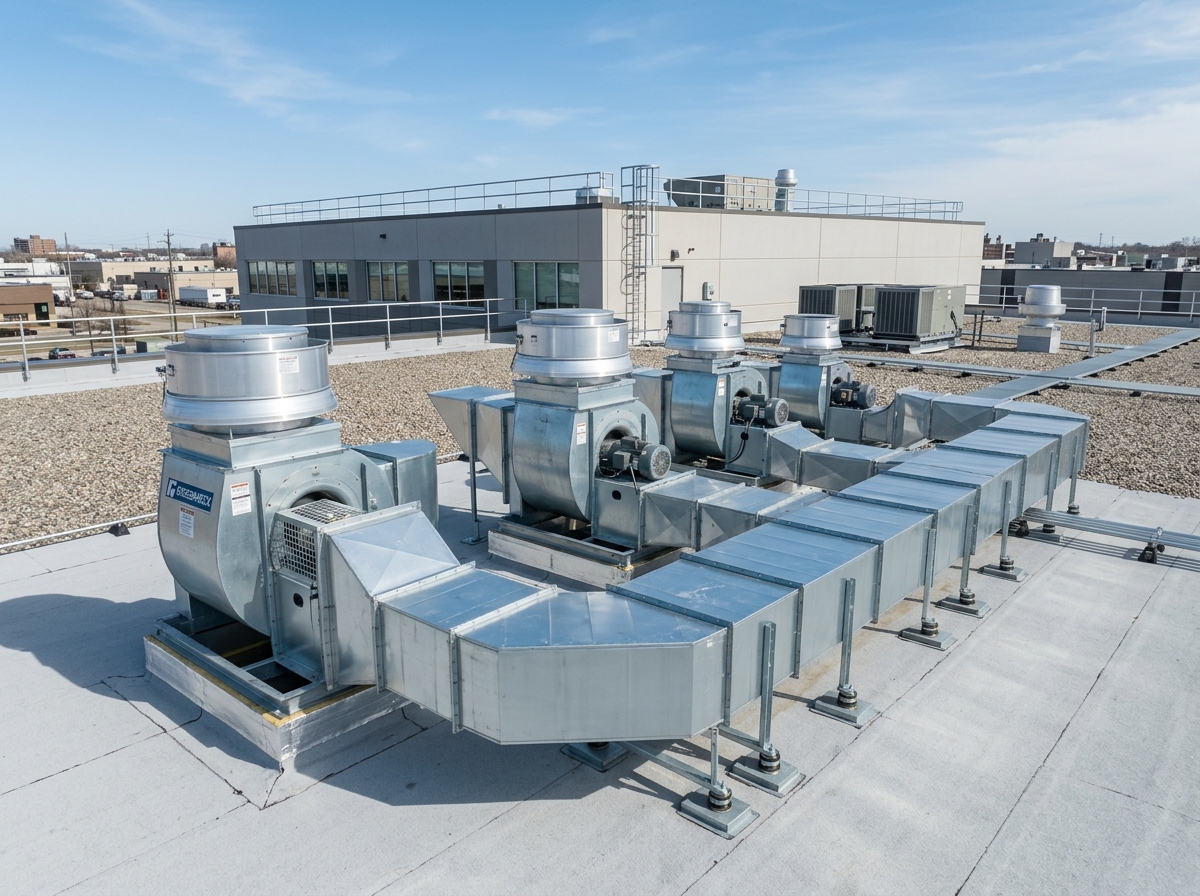
Heavy-duty galvanized commercial and industrial roof exhaust fans and ductwork

Commercial & Industrial Ventilation Support

Installation and repair solutions for rooftop centrifugal blowers, wall-mounted industrial fans, and commercial exhaust ductwork systems.

Industrial Exhaust Fan Installation

Equipment mounting and replacement for commercial facilities requiring steady high-volume air movement.

  • Rooftop upblast and centrifugal commercial exhaust fans
  • Wall-mounted louvered industrial exhaust fan installations
  • Replacement of aging commercial ventilation blowers and housings
  • Warehouse, shop, and utility room exhaust system setup

Commercial & Industrial Fan Repair

Troubleshooting for belt-drive and direct-drive exhaust units experiencing reduced airflow or mechanical wear.

  • Belt tension, pulley alignment, and bearing wear checks
  • Excessive blower vibration and housing noise diagnostics
  • Motor starter, disconnect, and control circuit troubleshooting
  • Damper, louver, and airflow performance inspections

Common Symptoms & Repair vs. Replacement Guide

Evaluate mechanical warning signs on commercial and industrial blowers to decide between component service and full unit replacement.

Commercial & Industrial Exhaust Fan Troubleshooting Reference
Observed Symptom Common Cause Typical Next Step
High-pitched squeal on startup or under load Loose, cracked, or glazed drive belt or misaligned pulley sheaves Inspect belt wear, adjust motor base tension, and align sheaves
Heavy vibration or rhythmic knocking Worn shaft/pillow-block bearings, material buildup on wheel, or cracked blades Check bearing play, clean wheel, and inspect balance weights
Motor runs hot or trips starter overload Excessive belt tension, seized bearing drag, voltage drop, or wrong sheave speed Measure motor amperage draw against nameplate FLA and check mechanical drag
Minimal exhaust draw despite spinning motor Broken drive belt, fan wheel spinning backward (reversed 3-phase), or stuck damper Verify belt integrity, wheel rotation direction, and damper linkage

When Component Repair Usually Fits

Many belt-drive and direct-drive commercial housings stay serviceable for years with targeted part replacement.

  • Drive belts, adjustable pulleys, or shaft bearings have reached wear limits
  • Roof disconnect switch, contactor, or speed controller malfunctions
  • Backdraft damper blades stick or actuator linkage comes loose
  • Aluminum housing, curb seal, and wheel remain structurally intact

When Unit Replacement Makes More Sense

Replacing the entire exhauster prevents repeat downtime when housings corrode or facility loads change.

  • Corroded curb flange, cracked fan wheel, or bent drive shaft
  • Motor winding failure on an aging or obsolete blower frame
  • Facility renovation requiring higher CFM or higher static pressure capability
  • Frequent downtime costing more in lost productivity than a new assembly

Commercial Sizing, Air Changes & Selection Guide

Commercial ventilation is typically planned around room volume, Air Changes per Hour (ACH), and static pressure across ductwork.

Typical Commercial Ventilation Guidelines by Facility Type
Facility / Space Type Typical Air Changes Common Fan Style
Warehouse & General Storage 4 to 6 ACH Wall-mounted louvered or roof axial fan
Mechanical, Boiler & Electrical Rooms 6 to 10 ACH Direct-drive wall or roof centrifugal unit
Auto Service Bay, Welding & Shop 10 to 15 ACH High-CFM belt-drive wall or upblast fan
Commercial Kitchen & Prep Exhaust Duct & Hood Spec UL-listed upblast centrifugal roof exhauster

What Details to Have Ready Before Calling

Facility managers and business owners can speed up troubleshooting or replacement planning with a few basic unit details.

Call Now: (866) 512-0604
  1. Space Use & Room Volume

    Share the facility type (warehouse, workshop, prep area, mechanical room) and approximate square footage/height.

  2. Mount Style & Roof Access

    Note whether the fan is rooftop-mounted, wall-mounted, or inline ducted, plus ladder/roof hatch access.

  3. Power Supply & Drive Type

    If known, mention whether the unit is direct-drive or belt-drive and 120V/230V single-phase or 3-phase.

  4. Nameplate Info or Fault Symptoms

    Have any model nameplate details handy—or describe belt noise, vibration, weak suction, or tripped disconnects.

Industrial Exhaust Fan FAQs

Common questions from facility operators and property managers about commercial exhaust systems.

Need Industrial Exhaust Fan Service?

Call The Fan Installers to discuss commercial or industrial exhaust fan installation and repair.

Call Now: (866) 512-0604